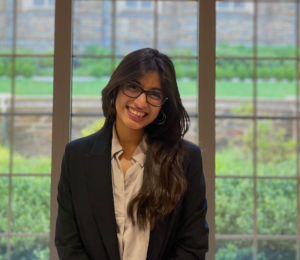
Delivery robots - they’re so cute!
Hot chocolate with whipped cream (always a hot chocolate chat with me, never a coffee chat)

You're moving from GE Aerospace to Citi as a Technology Summer Analyst, two industries that both rely heavily on AI. What does that range tell you about yourself and where you're headed?
Both sectors demand precision, because even minor decisions can have far-reaching consequences, whether that’s safety in aviation or security for banks. What this range tells me about myself is that I thrive in complexity and pressure. I like learning in unfamiliar spaces and understanding how they work to find where technology can innovate. For me, artificial
intelligence is most valuable when it is applied with practicality, purpose and most importantly, accountability.
I’m headed towards a place where I want to be in roles, in which I can understand both the technical side and the bigger picture: how decisions are made, who they affect and whether they genuinely improve outcomes.
Your nonprofit, APSTEM, was founded on the belief that STEM should be more accessible and inclusive. Was there a moment in your own journey when that felt less like a mission statement and more like something personal?
There were many moments in my journey where I became very aware of how inequitable access to opportunities can be particularly for students who lack networks and mentorship, or even institutional guidance. What made it personal was seeing capable students underestimate their own potential, simply because they had never been exposed to what was possible for
them. I saw elements of my own experience in that reality – I never had pre-existing corporate connections or the privileges often sustained by nepotistic structures and I understood exactly how talent can be overlooked when access is not equitable.
That is where my belief in meritocracy became central. I wanted to contribute to a system where individuals are evaluated on competence and curiosity rather than proximity to influence. APSTEM became more than an organisation – it was made to be a platform for advocacy and open opportunity.
You were shortlisted for SheCanCode's STEM Role Models Award. What does being recognized as a role model mean to you at this stage of your career, especially knowing you're still early in it?
Being recognised as a role model this early in my career is both humbling and motivating. I do not see it as a reflection of having “made it,” but rather as a reminder that impact does not depend on seniority. Even at an early stage, the way you advocate and lead others can change and empower someone else’s path. It’s also a reminder that it’s never “too late” to start
something either. It really encourages me to continue building with intention and to remain grounded in the responsibility that comes with it.
You carry a lot: research, founding work, internships, and advocacy. How do you actually take care of yourself in the middle of all of it?
I have learnt that sustainability matters just as much as ambition. Taking care of myself means setting boundaries with myself and work and making time for the people and things that keep me happy and disciplined. Very recently, I realised that productivity shouldn’t come at the expense of your wellbeing or mental health. The work I do matters to me but I know I can only do it properly if I’m also looking after myself.
You recently presented a poster on using mass spectrometry and machine learning to detect cancer-related biomarkers through breath analysis. What first drew you to a problem that sits at the intersection of machine learning, medicine, and chemistry?
What attracted me to this problem was the idea of using technology to make healthcare more accessible earlier rather than being reactive. I was fascinated by the thought that something as simple as our breath could contain patterns that we’re currently missing.
It also stood out to me because it brings together different areas like chemistry, medicine and technology in a practical way. I like problems that don’t have a single angle of thought, because they make it clear that real progress only happens when different disciplines come together. I loved trying the research side of academia too, especially having been in the industry side of technology for almost a year.
What responsibility do you think the people building AI tools in high-stakes industries like aerospace and finance carry, and how does that shape the way you approach your own work?
People building AI tools in these high stake industries have a lot of responsibility because those systems can affect, not just decisions made, but people too. For me, that means it’s not enough for something to just work well technically, you must think about how it’s being used and what could go wrong. It’s made me more careful in how I approach my own work and I try to always step back and think about the overall picture, not just the output.
What does being a part of RTC mean to you? Any key memories?
Being part of Rewriting the Code has allowed me to participate in what I’d call: “a chain of advice and opportunity for young women in technology”. You join, you learn and you pass knowledge on.
What stands out most about RTC is the people. RTC is one of the few spaces where I have never felt imposter syndrome because it’s made to ensure a sense of belonging that reminds you that you deserve to be in the room.